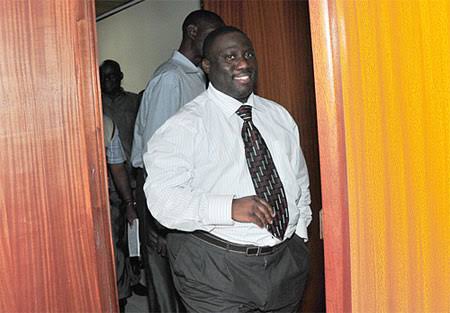
The jailed former Principal Accountant in the Office of the Prime Minister, Geoffrey Kazinda, has mounted a spirited legal fight, raising serious questions over what he describes as continued persecution and challenging the competency of the Attorney General’s appeal before the Supreme Court.
In an affidavit filed before the Supreme Court, Kazinda argues that the Attorney General’s appeal arising from a landmark Constitutional Court judgment in his favour is incompetent. He contends that the Supreme Court was misled by officials from the Attorney General’s Chambers into issuing orders staying the execution of the Constitutional Court’s decision.
Kazinda states that the Attorney General failed to institute an appeal within the mandatory 60-day period prescribed by law. He argues that under the Supreme Court rules, the Attorney General was required to withdraw the appeal that was filed out of time, prompting him to raise a preliminary objection to the stay of execution of the Constitutional Court orders.
He further explains that while awaiting the court’s determination on the application for stay of execution, he was served with a Memorandum of Appeal and the record of proceedings from the Constitutional Court, which he claims were filed illegally.
“I also learnt that the judgment and record of proceedings of the Constitutional Court were available for collection by the respondent more than a month before the hearing commenced. The letter from the Registrar of the Court of Appeal to the respondent, communicating the readiness of the proceedings for collection, reads…,” Kazinda stated in his affidavit.
He adds that as he waited for the Supreme Court’s ruling on the competence of the appeal, he was shocked to receive a ruling staying the execution of the Constitutional Court orders.
Kazinda notes that following the issuance of the stay of execution orders, he did not receive any fresh Memorandum of Appeal, record of appeal, or other court documents to confirm whether the Attorney General had complied with court directives to properly institute the appeal without delay.
“I know that the actions of the respondent in filing Appeal No. 005 of 2020, when the determination of whether a valid appeal exists is still pending before a coram of seven justices, cannot override the orders of the full bench directing the respondent to properly institute an appeal. These orders were issued three months after Appeal No. 005 of 2020 had already been filed,” Kazinda stated.
The developments come as a panel of seven Supreme Court justices, led by Justice Professor Lilian Tibatemwa-Ekirikubinza, directed both parties to address and guide the court on key legal issues. Among them is the question of why Justice Ezekiel Muhanguzi, one of the judges who heard the petition at the Constitutional Court, did not sign the judgment on the grounds that he had been promoted to the Supreme Court, despite having participated in the hearing and drafting of the judgment.
Kazinda also told the court that he has been incarcerated since 2012 and subjected to what he describes as endless prosecutions by agents of the Attorney General at the Anti-Corruption Division of the High Court. He argues that he has already been convicted, sentenced, and completed serving the sentences imposed on him.