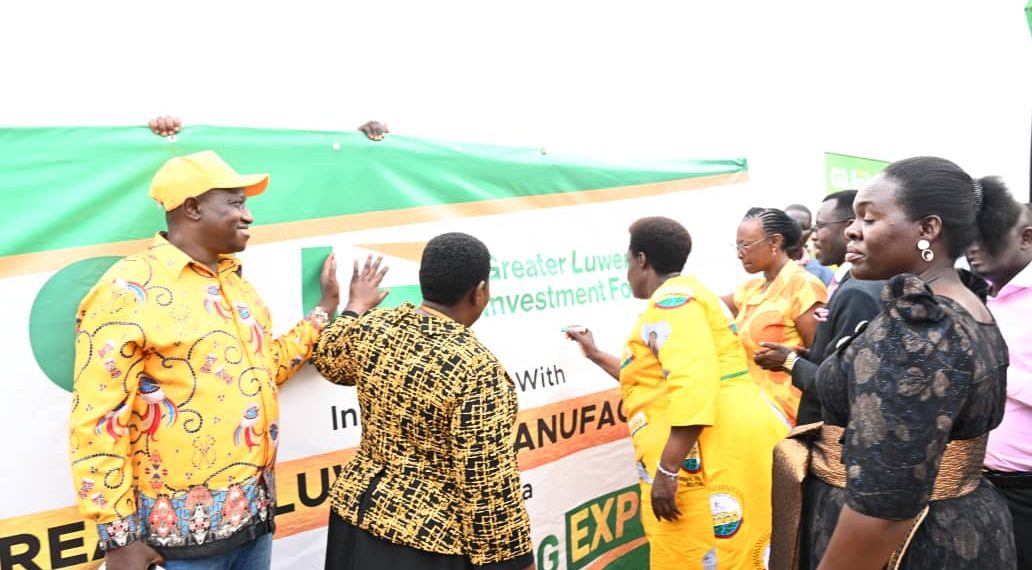
The Vice President, Maj. (Rtd) Dr. Jessica Alupo, has launched the Greater Luwero Investment Forum (GLIF), a dynamic platform that brings together industrialists, investors, entrepreneurs, and key stakeholders to drive sustainable development in the region.
The forum, established in March 2025, serves as a non-governmental and non-profit organization dedicated to fostering inclusive and sustainable development across the Greater Luwero region, comprising the districts of Luwero, Nakaseke, and Nakasongola.
Speaking during the launch held in Luwero District today, Vice President Alupo urged increased investment in Uganda’s four key wealth- and job-creation sectors: Commercial Agriculture, Industry/Manufacturing, Services, and Information and Communication Technology (ICT).Alupo encouraged Ugandans to become producers and entrepreneurs in these sectors to achieve economic independence and national growth, rather than relying solely on government jobs or subsistence living. She made the remarks on behalf of President Yoweri Kaguta Museveni, who is currently traversing the country ahead of the forthcoming general elections next week, where he is the NRM presidential flag bearer.
She told the gathering that moving from subsistence to profitable enterprises, embracing value addition, and utilizing infrastructure for wealth creation at the household level would help fight poverty and build a modern economy.
On Commercial Agriculture, Alupo emphasized the shift from subsistence farming to market-oriented production, citing the President’s Four-Acre Model. This includes high-value crops such as coffee, fruits, vegetables, and livestock enterprises like piggery (for non-Muslims), poultry, and fish farming as key drivers of wealth and job creation.
Regarding Industry and Manufacturing, she urged Ugandans to add value to raw materials—for example, processing maize into flour or animal feed—which creates more jobs than primary farming alone.
On Services, the Vice President encouraged the development of sectors such as hospitality, transport, retail, and professional services. In the area of ICT, she called for leveraging digital innovation for global opportunities, including online auditing and remote professional work through Business Process Outsourcing (BPO).Alupo noted that Greater Luwero currently boasts over 500 factories and industries scattered across the region and urged the population, especially the youth, to take advantage of employment opportunities in these factories. She added that the government would continue improving roads and other infrastructure to facilitate trade and lower the cost of production.
She stressed that when the NRM came to power in 1986, Uganda had only 80 factories nationwide, and urged the people of Luwero to vote for President Museveni in the coming general elections to protect these gains. Although Uganda’s exact number of factories is fluid, recent reports from 2024 and late 2025 estimate between 7,000 and over 9,000 factories, depending on definitions and sources.Congratulating the people of Luwero for their industrious achievements, Alupo said there was “every reason for them to thank God.” She further noted that Uganda is secure across all border points and that the government is committed to reducing the cost of production through the construction of roads, railways, and improvements in water and air transport to ensure goods reach markets efficiently.
“Government has done a lot in improving the country’s human resource. I ask everyone to support UPE, USE, and skills development through vocational education and training so that we have enough skilled labour for factories and industries,” she said.
On access to affordable credit, Alupo highlighted government-backed financing initiatives with reduced interest rates aimed at wealth and job creation. These include GROW funds (10%), the Agriculture Credit Facility (10%), the Small-Scale Business Recovery Fund (10%), Emyooga SACCO funds (9%), Large-Scale Investment financing (0%), the Parish Development Model (6%), and Emyooga commercial funds (8%), compared to the high rates charged by commercial institutions.
She also revealed that power tariffs for factories have been reduced from 13.8 USD cents per kWh to 8.6 USD cents, with a target of reducing them further to 5 USD cents per kWh. Large and extra-large factories are already consuming power at 5 USD cents during off-peak hours and 5.7 USD cents during peak hours.
“As government, we are moving progressively and pledge to continue investing in policies that support Ugandans in joining the money economy,” the Vice President said.
Alupo further disclosed that the government would soon engage stakeholders on the issue of a Minimum Wage to protect workers from exploitation and improve economic stability and well-being.
State Minister for Luwero Affairs, Alice Kaboyo, congratulated the region on its achievements and urged the government to develop affirmative action policies to ensure that residents of the Luwero Triangle benefit from employment opportunities in local factories.
The NRM Deputy Secretary General, Rose Namayanja, called on the people of the Luwero Triangle to vote for President Museveni and all NRM flag bearers in the general elections.
The launch of GLIF featured key activities including an Annual Investment Expo, a Thanksgiving Mass, and a conference that brought together stakeholders to discuss development strategies, investment opportunities, corporate social responsibility, and factory sales. The events were organized by Maj. Herbert Ndiwalana, Personal Assistant to Gen. Salim Saleh, in collaboration with the Born-Again fraternity led by Bishop Gabriel Kijjambu, overseer of the National Fellowship of Born-Again Pentecostal Churches of Uganda.
Religious leaders applauded President Museveni for his visionary leadership, noting that it has delivered continued peace and stability across the country.