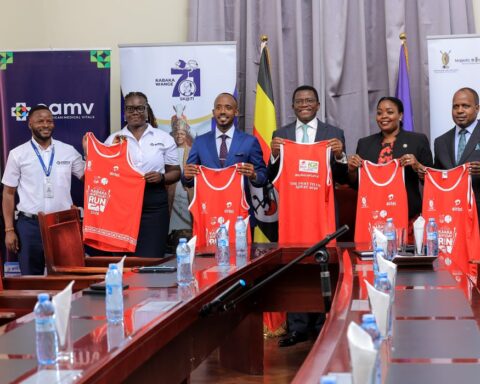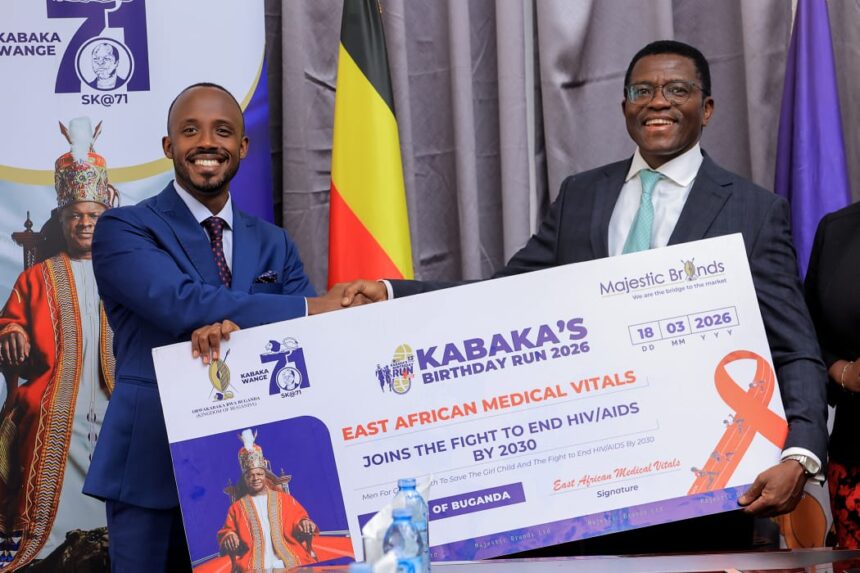
KAMPALA:Yesterday, 31 March 2026, inside the stately corridors of Bulange, Mengo, EAMV Managing Director Brian Kavuya handed a UGX 10 million cheque to Katikkiro Charles Peter Mayiga, confirming the company’s Silver Sponsorship of the 13th Kabaka’s Birthday Run. It would be easy to reduce this to a photo opportunity. But to do so would be to miss the deeper current beneath the surface.
East African Medical Vitals is the first manufacturer of powder-free latex surgical gloves on the African continent. Its factory in Namanve Industrial Park, Mukono, produces roughly 95 million gloves a year. Its participation in a cultural health marathon reveals a convergence that Uganda’s policymakers have been scripting for years: local industry, traditional authority, and national health goals pulling in the same direction.
A Run That Reads Like a National Development Blueprint
Uganda’s Fourth National Development Plan (NDP IV), covering FY 2025/26 to 2029/30, was approved by Parliament in January 2025. Its goal is higher household income and employment for socio-economic transformation, pursued under the banner of “sustainable industrialization for inclusive growth, employment, and wealth creation.” It is the first of three five-year blueprints designed to deliver a tenfold expansion of the economy by 2040.
NDP IV rests on five strategic objectives: increasing production, productivity, and value addition; enhancing human capital development; supporting the private sector to drive growth and create jobs; building strategic infrastructure; and strengthening governance.
EAMV’s sponsorship of the Kabaka Run touches at least three of these in a single event: a Ugandan factory turning imported latex into a finished medical device (value addition and import substitution); a cultural institution mobilising over 130,000 citizens around a public health message (human capital); and a private company channelling revenue back into community health advocacy (private sector as a development partner). This is NDP IV happening in the real world.
Made in Namanve: The Industrial Story Behind the Cheque
EAMV was established by Ugandan entrepreneur Ben Brian Kavuya at a cost of approximately USD 14.5 million, with significant financing from the East African Development Bank. Since producing its first glove in 2021—an event that drew President Museveni to Namanve—the company has grown into a regional medical supplies partner serving East and Central Africa, holding ISO 13485:2016 certification for medical devices and Q-Mark certification from the Uganda National Bureau of Standards.
The numbers carry strategic weight. At full capacity, EAMV meets approximately 70 percent of Uganda’s domestic glove demand. Before the company existed, every surgical glove used in a Ugandan theatre arrived by sea, taking up to three months. EAMV now delivers in three to five days. It has secured a ten-year off-take agreement with the government covering 30 percent of the national glove market, and its operations have stemmed forex outflows of an estimated USD 17.8 million annually. A second production line, launched in early 2025, has expanded capacity further and created hundreds of additional jobs. This is precisely the enterprise NDP IV envisions when it calls for “establishing factories that use locally available raw materials” and “promoting exports and import substitution.”
Running Towards 2030: The HIV Data That Demands Action
This year’s Run carries the theme “Men for Good Health to Save the Girl Child and the Fight to End HIV/AIDS by 2030.” It refuses to be polite about the epidemiological reality: men remain a significant transmission vector, and adolescent girls and young women bear a disproportionate burden of new infections.
The progress is real but incomplete. According to UNAIDS, national HIV prevalence among adults aged 15–49 declined to 4.9 percent in 2024, down from 7.3 percent in 2010. New infections fell by 61 percent over the same period, from 96,000 to 37,000 annually.
Antiretroviral therapy now reaches over 1.3 million Ugandans. In the Buganda region, new infections fell by 21 percent between 2020 and 2024. Yet over 4,700 babies were still born with HIV in 2024 alone. The Katikkiro’s message was direct: knowledge, awareness, and open communication remain the strongest weapons. NDP IV identifies human capital development—including health outcomes—as a pillar, recognising that no economic transformation is durable without a healthy population. The Run’s theme is not merely a health slogan. It is a development argument.
What Corporate Uganda Can Learn From a Pair of Gloves
NDP IV’s total cost over five years is estimated at UGX 593.6 trillion, of which 30.4 percent—roughly UGX 180.4 trillion—is expected from the private sector. That is not charity; it is co-investment in national transformation.
EAMV’s UGX 10 million may be modest, but it represents something larger: a company that manufactures a frontline health product choosing to invest in a community health platform aligned with cultural tradition and national policy. “Our sponsorship is a testament that we have our communities at the heart of our business,” Kavuya said at the handover.
The Katikkiro acknowledged EAMV’s gloves as a key component of Uganda’s medical landscape and called on men to take the lead against HIV. Companies that simultaneously create jobs, substitute imports, build industrial capacity, and invest in community health demonstrate what NDP IV’s private-sector pillar looks like when it actually works.
Culture, Commerce, and the Road to 2040
Uganda’s Vision 2040 aspires to transform the country into a modern and prosperous society. NDP IV is the vehicle for the next leg of that journey. But plans do not implement themselves. They require actors: enterprises that manufacture, institutions that mobilise, and citizens who show up.
When Brian Kavuya walked into Bulange with a cheque, he demonstrated what it looks like when a Ugandan manufacturer—built with East African capital, producing a product that saves lives in Ugandan theatres—reinvests in the health of the communities it serves. That is not philanthropy. That is development in motion.
The 13th Kabaka’s Birthday Run takes place on Sunday, 12 April 2026, flagged off from Lubiri, Mengo. Kits are available at UGX 20,000. Race categories: 21 km, 10 km, and 5 km.